



By Christine Wangoi, DevReporter, Kajiado
Climate change, prolonged droughts, shrinking grazing areas due to land subdivision and competing land uses, are forcing pastoralists to reconsider how they keep livestock.
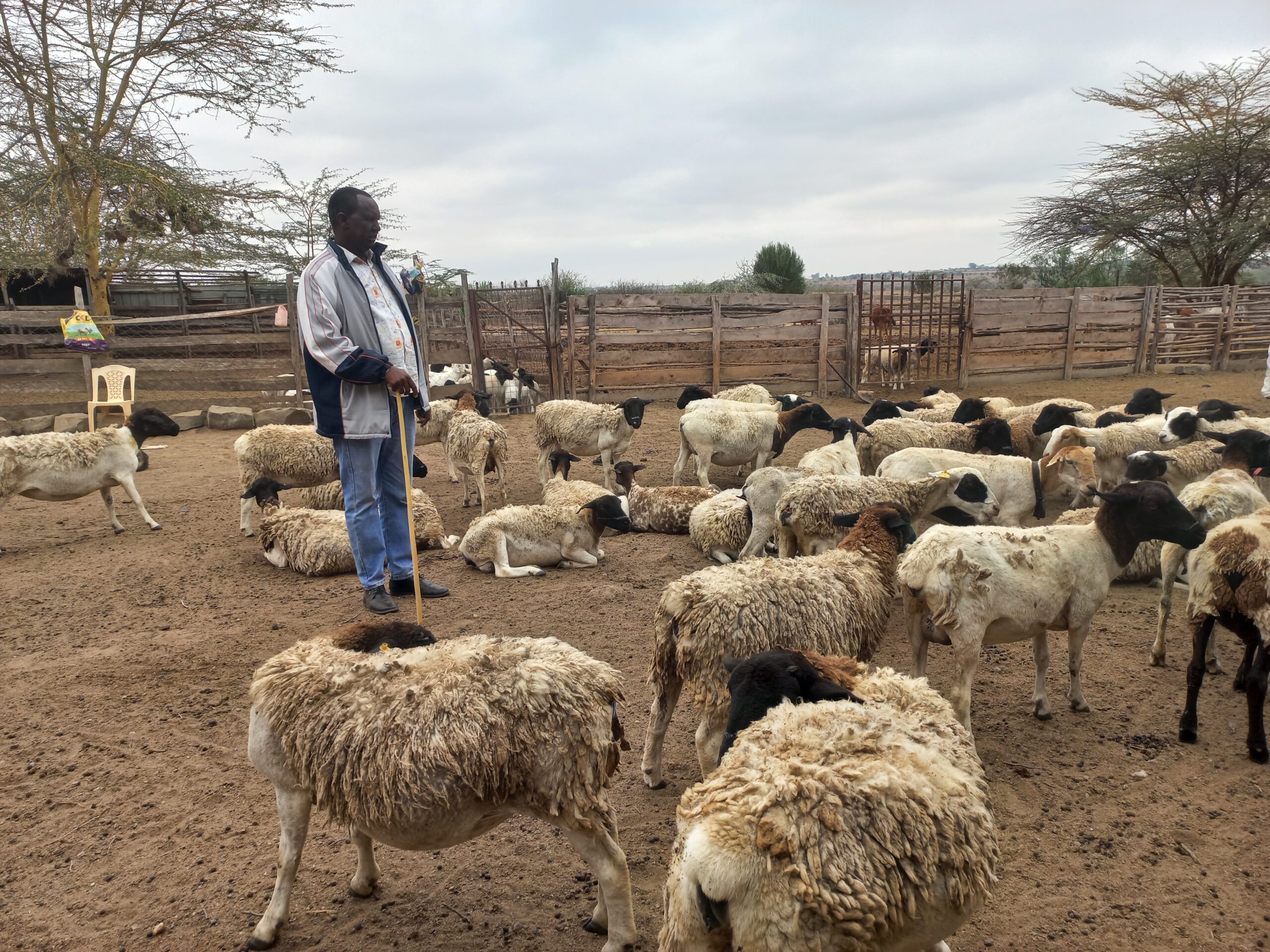
Across Kajiado County, a quiet transformation is taking place in Maasai pastoralism. Herders are now adopting Dorper sheep as opposed to the indigenous Red Maasai Sheep. Pastoralists say that cattle keeping as the sole source of livelihood and social status is no longer sustainable.
To most farmers, prolonged drought has pushed them to diversify livestock enterprises and adopt animals that are more profitable and sustainable in smaller chunks of land.
Samuel Ole Koisaini, a farmer from Kimalat, Kaputiei North, says that it is no longer about a big herd size but quality, profitability and sustainability.
“The drought situation has changed the way we keep livestock. We can no longer depend entirely on large herds of cattle because when the rains fail for a long time, we lose many animals. Dorper sheep require less space. When grazing conditions are difficult, Dorper sheep’s survival chances are higher. I was introduced to this breed in 2021 by a farmer friend in Laikipia. I toured his farm several times and I gained interest in his farming practice. He offered me free training at his farm. I sold thirty indigenous sheep and bought four mature dorpers. One ram and three ewes. One ewe died. I watched the remaining two reproduce. After one year, I was convinced to sell my entire herd of 42 goats and whole heartedly ventured into the breed. As the dry spell prolonged over time, I lost all my cattle to the 2022 drought. Dorpers survived on little feeding,’ narrates Koisani.
He further says that grazing areas have rampantly diminished as communal land is subdivided into smaller individual parcels.
“The effects of unpredictable prolonged dry spells have been worsened by continuous land subdivision, reducing range lands. Even with enough rains, the pasture is short lived. Individuals have fenced off their land and put them into other uses,” says Koisani.
Koisani further says that he is keen and focused on educating more farmers on the benefits of modern farming.
“My home is gradually becoming a free demo farm for training herders on the need for adopting modern farming. When we face drought, it is not selective. The effects cut across all of us, that is why we want to make the transformation communal. Advancing together will reduce dependency levels in households, families and communities at large,” added Koisani.
According to the National Drought Management Authority (NDMA), herders in Kajiado lost 45 percent of cattle to the 2022 drought.
According to Moses Olum, a senior officer at the Kenya Agricultural and Livestock Research Organization (KALRO), the characteristics of Dorper sheep make them more resilient and suitable for animal diversification in dry areas.
“One of the advantages of Dorper sheep is their ability to grow and survive under relatively harsh conditions. They have high meat yield, grow relatively fast and farmers can keep more sheep on a smaller area compared with cattle. They are also non-selective grazers and able to utilize pasture. This makes them a viable option for farmers who are dealing with reduced grazing land,” said Olum.
Samuel Ole Tupet, another farmer, says that his experience with Dorper sheep has convinced him that livestock diversification can strengthen household resilience.
“We cannot control rain but we can change how we respond when the rains fail. During the dry period, I have seen the sheep continue performing better than I expected. There is a ready market for the animals due to the quality of its meat. The improved sustainable income has helped me support my family and educate my children,” said Tupet.
A mature Dorper can weigh up to 30kgs, fetching up to Kshs 30,000 compared to a mature well fed indigenous sheep which weighs 14kgs and selling at an average of between Kshs 8,500 and Ksh11,000.
A Spot Check on various livestock markets and Meat Outlet Dealers when developing this piece, indicated a high demand for Dorper mutton.
“Dorper meat is tastier and softer, that is why you can see it is attracting a lot of customers. The animal is meaty, has fewer bones, cooks faster and that is an advantage to me as a small-scale trader. I am able to serve more customers,” said Jane Mwaura, a meat dealer at Isinya Town.
The duo’s experiences demonstrate how climate adaptation can have direct social and economic benefits at household level. It supports Sustainable Development Goal (SDG) 2 and 3, which advocate for No Poverty and Zero hunger respectively, through households’ income diversification and strengthening economic resilience.
Kajiado County Director of Livestock Production, Eric Ahenda, says that the growing interest in the exotic sheep is a wider transformation of livestock production in the county.
“Pastoralists are adapting to changing climatic conditions. We are committed to investing in livestock extension, animal health, breeding, markets and farmer training. This is essential in a bid to support the emerging value chain and deliver sustainable benefits,’’ says Ahenda, further noting that currently the population of Dorper stands at 800,000.
In August 2023, the County government of Kajiado launched an initiative dubbed ‘Modulated Pastoralism’. The ongoing programme entails civic education to rally herders to embrace modern farming. Volunteer farmers and professionals in the animal and crop experts are invited and given an opportunity to enlighten fellow farmers during public barazas.
Dorper rearing transformation is also creating opportunities for young people and women. The approach resonates with Article 60 of the Constitution of Kenya 2010, which calls for land to be held, used and managed in an equitable, efficient, productive and sustainable manner.
“Traditionally, livestock production in pastoral communities has been strongly associated with men, particularly cattle keeping. But the smaller scale and commercial nature of sheep production is a new opportunity for us,’’ narrated Ann Lasoi who has now ventured into Dorper farming.
To most farmers veterinary services remain a challenge.
“Access to animal health professionals is not easy and is expensive. We request for improved access to animal health services, affordable treatment and extension support to enhance this enterprise,’’ appealed Tupet.
To the farmers adopting Dorper, it is about breeds with ability to sustain livelihoods, enhance food security, create resilience and mitigate adverse effects of climate change as opposed to keeping large herds.

 Radio Baraza

