


By Lillian Onyango, National DevReporter
Jackline is one of the many traders who were affected by the burning of Gikomba market in 2020.
Until that fateful day, Jackeline had been a trader at Gikomba market for 20 years, before she was forced to leave the market after losing her stock following four fires incidences at the market.
“In the first fire, I lost Ksh 200,000 worth of stock, the second time, I suffered a loss of Ksh 150,000, and yet another loss of Ksh 180,000 during the third fire. When I lost Ksh 250,000 during the fourth fire, I had to leave the market.”
The 45 year old laments how the 2020 fire took her savings made from a loan she had taken. Jackeline now lives in constant fear of being sanctioned by the company that had issued the loan of Ksh 150,000 to her.
A mother who was in the past able to take her children to good schools, can now hardly afford a good meal for them since she is out of business. She says that this is something that breaks her from inside when she remembers how well her business used to do well.
She now does odd jobs and sometimes turns to friends for help when the jobs do not come by.
We arrived at her home and found her four children eagerly waiting for their mother who had managed to earn only Kshs300 on this day. Looking at her and witnessing the joy on her children’s faces upon her return, a moment quickly interrupted by other sights within the room, an empty tin of sugar in the hand of her youngest daughter for example, spoke a lot more about the real pain she and her family were going through.
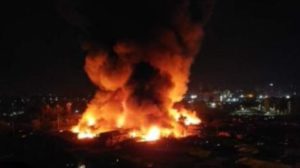 Hot blazing fire in Gikomba 2021. Photo: Courtesy of Kenya one.com
Other traders in Gikomba market
At Gikomba, the 1 pm sun is hot. On the outside, this market may not be a pleasant sight to behold – from the temporary constructed stalls, to the plastic roofing and onto the patched muddy tiny corridors. There is so much commotion as traders close sales with potential buyers.
Here, another trader, identifying himself only as Cris, had his head buried in his hand while sitting on his stock. He narrated how he has always suffered losses year after year.
“I’m a broker and my stock have burnt four times since 2011. I took three other loans and gave it a fresh start but again I am unable to pay since the businesses have not picked up since the last fire,” Cris said.
Unfulfilled promises
A number of other traders confided that promises of compensation by government officials whenever such fires occur remain unfulfilled. They said that they were promised security and installation of CCTV cameras, which promises are yet to be fulfilled.
“Every time fire burns Gikomba market, we see political leaders coming here in the name of standing with us. They give us false promises which are quickly forgotten when the story cools down,” said a trader who did not want his name revealed.
Government officials have always visited the market whenever these fire incidences occur, with promises of modernising the market and providing security. it is said that Interior Principal Secretary Karanja Kibicho promised compensation to the traders who had experienced loses in 2020. There are no indications that the promise has been fulfilled.
The mystery behind the fires
Media records show that the market has burnt more than 10 times. In the last ten years, these market fires have occurred in 2011, 2013 and 2016.
Curiously in 2021, the market burnt barely two days after the Nairobi Metropolitan Services (NMS) was given a nod by the High Court of Kenya to evict a portion of Gikomba traders to pave way for the expansion of Pumwani Health Centre. These eviction threats intensified after 15 acres of land belonging to Pumwani was allegedly grabbed, raising further questions.
Gikomba traders on the other hand are not willing to relocate to the new proposed market for fear of losing customers.
The traders argue that second hand clothes or mitumba as popularly known, are best sold in open-air markets, which are more attractive to walk-by buyers. Taking a stall in a mall or a storey building simply does not work.
Gikomba traders have even gone further to suggest solutions for curbing the frequent fires, for example installation of CCTV cameras to capture all the activities within the market, modernisation of the market and construction of a proper way in and through the market. Building of fire engines within the market and ensuring there is water always is another suggested measure.
A number of political aspirants have promised to stop the series of fires at Gikomba and pledged to upgrade the market in keeping with modern standards. Will these promises be acted on?

 Radio Baraza