


By Emanuel Kipkorir Tarus, DevReporter, Trans Nzoia County

Key Highlights
- Poultry farmers struggle with high cost of feeds, diseases and exploitation
- Members of TURMUS poultry cooperative society build abattoir to add value to their poultry, increase incomes
- The cooperative has created employment, reduced domestic violence, exploitation by middlemen
- Development partners, County Government of Uasin Gishu support farmers
- Farmers need greater support to realize sector’s full potential
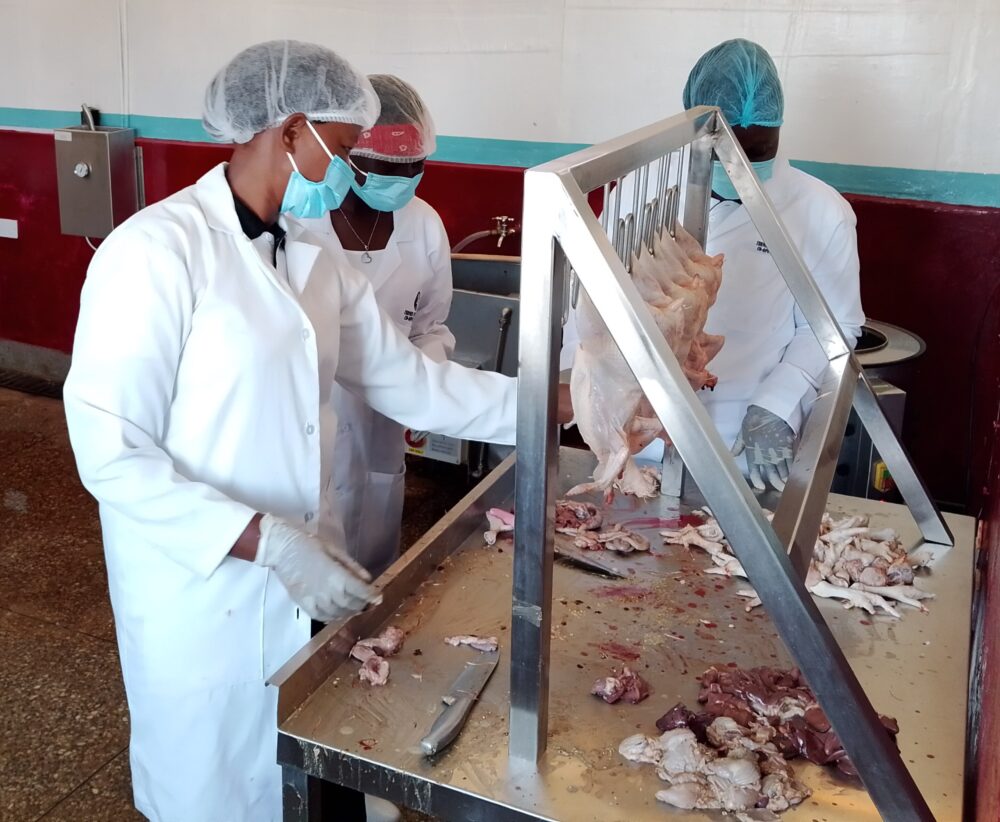
Activities inside a modern poultry slaughter facility at Kimumu Bahati Market in Uasin Gishu County, tells a story of transformation.
Workers in protective gear are busy slaughtering, cleaning, weighing, packaging and labelling chicken ready for the market. This is a sharp contrast to the days when farmers depended on exploitative brokers who dictated prices and left them with little profits.
For years, poultry farmers in Uasin Gishu County grappled with high production costs, diseases and exploitation by middlemen. Many were forced to sell mature birds for as little as KSh500, a price lower than the cost of production.
Tired of exploitation and determined to change their fortunes, the farmers formed the TURMUS Poultry Farmers’ Cooperative Society, bringing together members from Turbo, Sugoi, Cheptabach and Murgor. The farmers shifted from selling live birds to processing and packaging chicken products.
“We no longer rely on brokers because we now sell value-added products that fetch higher prices,” said the cooperative’s chairperson, Onesmus Maina.
The shift advances several Sustainable Development Goals (SDGs), including SDG 1 (No Poverty), by increasing farmers’ incomes, and SDG 2 (Zero Hunger), by improving the supply of safe and nutritious poultry products.
Beyond improving household incomes, the initiative is also empowering women.
Nearly 80 per cent of the cooperative’s members are women who now earn independent incomes, which aligns with SDG 5 (Gender Equality).
Leah Metto, a farmer from Tapsagoi, said that the venture has transformed her family’s financial stability and strengthened harmony at home.
“I can now contribute to household expenses and even buy food for my family. That has brought more peace and respect at home,” she said.
She added that her financial independence has reduced domestic violence.
Jane Maiyo, the cooperative’s secretary, talked of plans to expand production, create employment opportunities for young people and access regional and international markets.
The transformation has been supported by Hand in Hand Eastern Africa, which financed the construction of the poultry slaughter facility and farmers’ training.
Its Chief Executive Officer, Albert Wambugu, said that the project was designed to increase farmers’ productivity, improve market access and build sustainable livelihoods.
“We helped Turmus poultry cooperative to establish this slaughter house, the members raised 10 percent of the cost,” he said.
Agricultural extension officers, led by Julius Kiprop, said that the facility has the capacity to process more than 1,000 birds daily into assorted chicken cuts.
Uasin Gishu County Executive Committee Member for Trade, Philip Chebunet, said the initiative supports Kenya’s Bottom-Up Economic Transformation Agenda (BETA) and Kenya Vision 2030 by promoting agribusiness, industrialisation, job creation and food security.
Despite the progress, farmers say more investment is needed in processing equipment, cold storage facilities, affordable financing and market expansion to unlock the sector’s full potential.
As more smallholder farmers embrace value addition, the success of the TURMUS Poultry Farmers’ Cooperative Society demonstrates that cooperation, innovation and market-oriented agriculture can transform poultry farming from a subsistence activity into a profitable and sustainable enterprise.
Related Stories


 Radio Baraza