


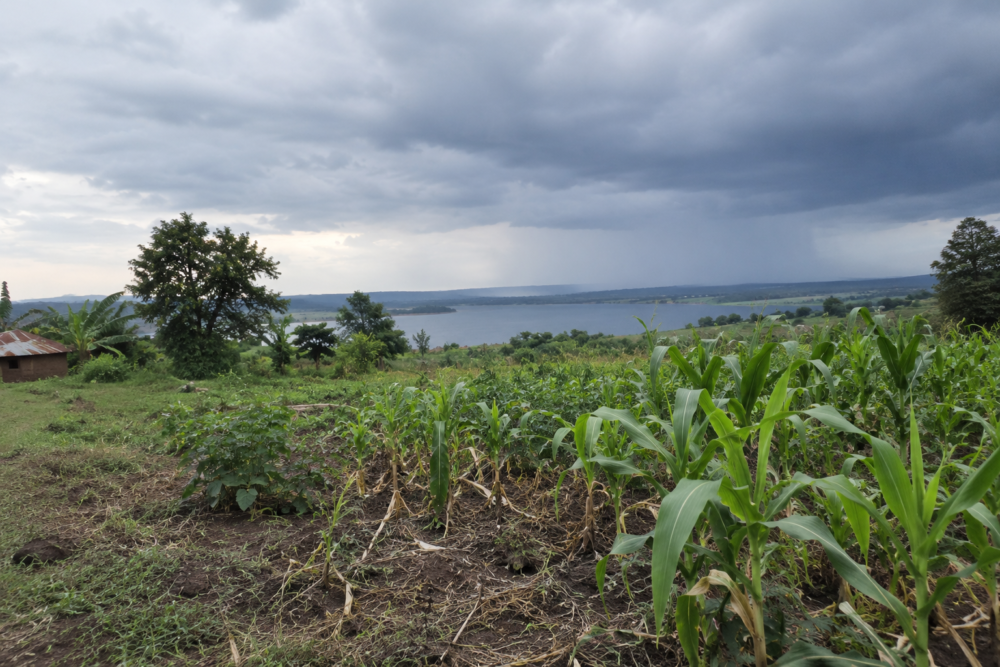
By Philip Barasa Muyomi, DevReporter, Busia County
Agnes Anyango no longer plants when the calendar tells her to. The rains that once arrived like clockwork after the long dry season now come late, or not at all, or too much at once.
In Nambale sub-county, where she farms a quarter acre plot of capsicum and kales, the certainty that once anchored her family’s income has dissolved into guesswork. Like many smallholder farmers across Busia County, she has learned to read the sky rather than the almanac, watching for signs that were once unnecessary but are now essential to survival.
Anyango is one of 249 smallholder farmers surveyed in a 2026 study on climate resilience in Busia County. The findings paint a stark picture: 33 percent of farmers reported prolonged droughts, 31 percent cited rising temperatures, and 65 percent rated the impacts as “very severe.” Food insecurity followed for 63 percent; poverty for 28 percent. These are not distant statistics. They represent households where children go to bed hungry, where school fees go unpaid, and where the careful savings of a lifetime can be erased by a single failed season.
The numbers confirm what farmers here have felt for years. Busia sits in the Lake Victoria Basin, a region the Kenya Meteorological Department projected would receive near average to above average rainfall during the March–May 2026 long rains, but with a catch. The season was expected to have a “normal to late onset” and to be characterised by “intermittent dry spells.” For farmers, that translates to a cruel uncertainty: the rain will come, but when, and will it stay?
When rains arrive late, planting is delayed and the growing cycle is compressed. When dry spells stretch between showers, seedlings wither before they can establish roots. When heavy rain falls in bursts, topsoil washes away and crops rot in waterlogged fields.
The meteorological department’s own impact assessment for the 2026 long rains warned of “declined crop performance due to limited rainfall” and “reduced income from agricultural production” in areas expecting below average precipitation, alongside the opposite risk of flooding, waterlogging, and nutrient leaching where rains were expected to be above average.
For Busia, both risks apply, sometimes in the same season. A farmer may watch her maize wilt in a dry spell only to see the same field submerged weeks later. Yet the county is not standing still. Through the Financing Locally Led Climate Action (FLLoCA) programme, the Busia county government has established a 30-acre climate resilient horticultural park at Benga village in Nambale, allocating quarter-acre plots to 120 farmers and providing seeds for capsicum, kales, and watermelons. The project includes an intake weir, a raised steel water storage tank, and solar-powered irrigation—eight acres under drip irrigation, 22 under sprinklers.
Anyango, who farms at the scheme, says the change has been transformative.
“I used to depend on my neighbors for food,” she said. “Now I grow capsicum and kales which generates roughly Sh2,500 on a weekly basis.”
That income has restored a measure of dignity and independence she thought she had lost.
But irrigation is only one piece of the puzzle. The 2026 study found that while access to climate information is high—38 percent of farmers act on short-term forecasts via radio, 47 percent via television—effective adaptation depends on confidence, clarity, and relevance. Awareness of the Kenya Meteorological Department was significantly associated with education and farming experience, and farmers with less formal schooling were less likely to act on seasonal forecasts.
That gap matters. A separate study of Nambale farmers found that inadequate access to seasonal and sub-seasonal forecasts limits farmers’ ability to adapt, contributing to continued agricultural failure among smallholders. The information exists; the challenge is translation—making a meteorological bulletin mean something in a farmer’s field. A forecast of “below-average rainfall” is meaningless without guidance on what to plant, when to plant it, and how to protect it.
Meanwhile, the county is also pushing improved seed varieties. Millet farmers in Teso South have been encouraged to adopt drought-tolerant varieties such as U15/Maridadi and Kakamega Wimbi 2 and 3, which mature in three months rather than six, and can be planted three times a year.
Mary Awala, a farmer who adopted the improved seed, said that the change helped her pay school fees for her children. For fish farmers, the Kenya Meteorological Department in Busia has been training pond and cage operators to use seasonal forecasts to prepare for flooding and manage water levels.
Busia County Director of Meteorology, Benjamin Bahati, said that farmers should get seasonal forecasts “so that as they farm, they already know the expected amount of rain.”
The broader forecast for the region offers little comfort. For the October–December 2026 short rains, the meteorological department predicted above-average rainfall across more than 40 counties, with Busia among those expected to see rains continuing from September into January.
The El Niño event driving the forecast was described as potentially “very strong.” For farmers, that means the threat may shift from drought to deluge—waterlogged fields, post-harvest losses, and pest outbreaks. The same farmers who prayed for rain may soon pray for it to stop.
Back in Nambale, Michael Barasa, another farmer at the Benga scheme, has a request;
“Busia County is often faced by the challenge of perennial rainfalls and flooding,” he said.
“I urge FLLoCA to consider constructing greenhouses which will protect our crops and our pockets.” he concluded
It is a modest “ask” in the face of a climate that has become anything but predictable. But it reflects the central reality for Busia’s farmers: adaptation is no longer about preparing for one kind of bad season. It is about preparing for all of them at once—drought and deluge, heat and cold, uncertainty as the only constant.
Help us keep you posted! Join our community today!

 Radio Baraza
