


By Christine Wangoi Musa, DevReporter Kajiado County

Key highlights
- Acute and persistent water shortage in Kitengela dates back to 2019
- Clean water at Kitengela cost up to Kshs70 for a 20litre jerrican
- The National Government banned the Export Processing Zone Authority (EPZA) from selling clean water in 2019.
- The County government utilized Kshs.20Million to put up 8 clean water kiosks, a project that has since collapsed.
- Proliferation of unregulated private water vendors
- Residents fear possible water borne diseases due to frequent water contamination.
- Residents push for collaboration between National and County governments to ensure water availability in the town.
Residents of the populous Kitengela town continue to grapple with an acute water shortage despite its elevation to a municipality. The town, famous for dust and lucrative Nyama Choma business, has increasingly fallen under the grip of largely unregulated water vendors.
Rising Cost of Water
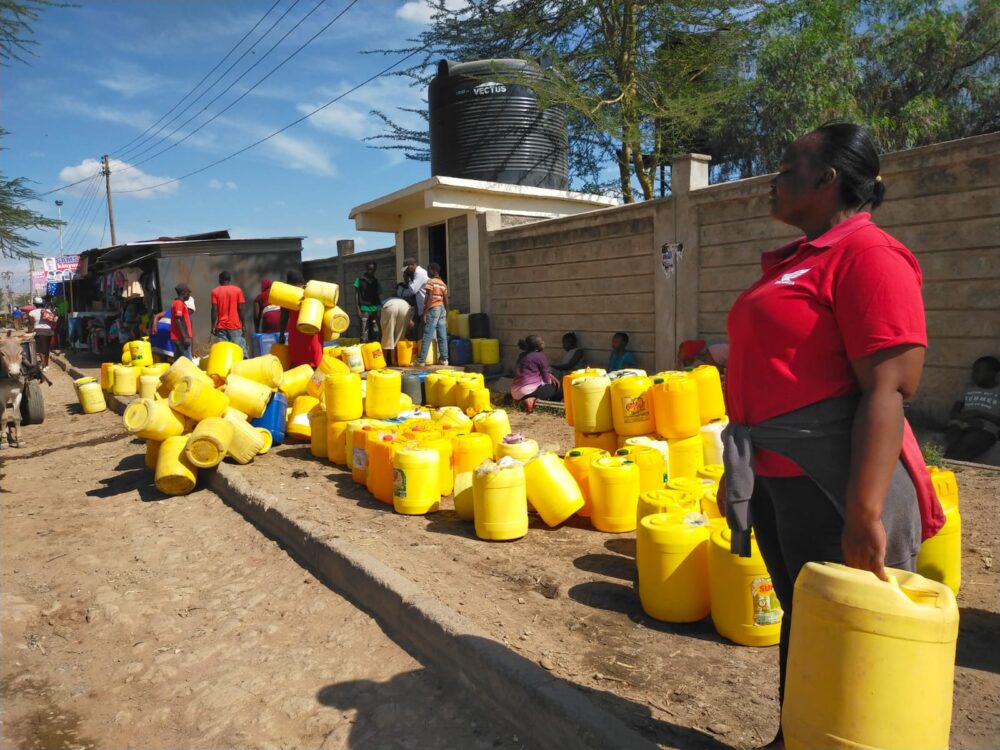
Clean water retails at between KShs30–50 per 20-litre jerrican, while saline water sells for KShs10–20. Long queues at water points, a surge in roaming vendors with bowsers and donkey carts, numerous informal kiosks, and abandoned water supply points reflects the severity of the crisis.
A much-publicized national government water project launched in 2019 has since stalled, becoming what residents describe as a white elephant. At the time, clean water was sold at just KShs3 per 20-litre jerrican, a price that is now a distant memory.
The national government later banned the mandate for Export Processing Zones Authority (EPZA) businesses to supply water, citing perceived conflict of interest.
In its stead, the County Government established eight kiosks to distribute clean water sourced from Mavoko, which in turn draws supply from Nairobi. However, this initiative collapsed within eight months.
Efforts by the County Government to negotiate the takeover of EPZA’s existing water infrastructure were unsuccessful. Governor Joseph Ole Lenku defended the county’s decision at the time, stating that the KShs20 million spent on the kiosks was more affordable compared to the unspecified cost of acquiring the EPZA owned infrastructure.
Overlapping Government Mandates
Under the Kenya 2010 Constitution, Water is a shared responsibility between the national and county governments. The National government is the watchdog of water resources and mega projects, while supply and Sanitation services have been devolved to county governments.
Experts argue that overlapping mandates between national and county governments, coupled with opaque decision-making, have created loopholes that allow inefficiency and mismanagement to persist.
“The collapse of successive water initiatives, lack of regulatory oversight over private vendors, and failure to safeguard public infrastructure, point to weak institutional frameworks and possible vested interests undermining service delivery. Without transparent procurement processes, clear delineation of responsibilities, and stronger regulatory enforcement, public resources will continue to be wasted while essential services like water, remain inaccessible to those who need them most,” says Mumbe Joseah, an advocate on environmental issues.
Residents have since voiced deep frustration with both levels of government, accusing them of mismanaging resources and failing to deliver a sustainable solution.
“As residents of Kitengela, we are bearing an overwhelming financial burden just to access water, which is an essential basic need that should be affordable and readily available. Water has effectively become a goldmine here because of its scarcity and high cost. It is both shocking and disheartening that a town with a municipal status still lacks reliable water supply. Millions of shillings were reportedly invested by both the national and county governments in a project that does not exist in practice. Those responsible must be held accountable and explain how an entire population was misled over such a critical resource,” says Alex Musembi, a resident.
Residents also question why an affordable piped water service was discontinued, yet private vendors continue to source water allegedly from the same Nairobi supply, and selling it back to locals at significantly inflated prices.
Health and Safety Concerns
Concerns have also been raised about the safety and quality of the water sold by vendors, with some residents alleging the existence of powerful cartels controlling supply.
“We are deeply concerned about the safety and cleanliness of the water we are being forced to buy. There is little to no transparency regarding where this water is sourced from, and how it is handled before it reaches consumers. Without proper regulation and oversight, the risk of contamination is very real. This poses serious health dangers to families relying on this water every day,” says Kurgat Kibet, a resident.
Although saline water is more affordable, residents say its supply remains inconsistent and insufficient to meet demand. The town has relatively few privately owned boreholes, largely because for many years, residents had relied on a steady supply of clean, piped, and metered water.
The crisis persists despite clear constitutional guarantees. Article 43(1)(d) of the Constitution of Kenya 2010 states that ‘every person has the right to clean and safe water in adequate quantities’.
Residents argue that the ongoing situation in Kitengela represents a direct violation of this right, calling for urgent intervention by, and accountability from both national and county governments to restore reliable, affordable, and safe water access.
The situation also raises concerns about the delayed realization of Kenya Vision 2030, the country’s long-term development blueprint aimed at transforming Kenya into a newly industrializing, middle-income nation with a high quality of life for all citizens. Reliable access to clean and safe water is a key pillar under its social development agenda.
Residents note that without consistent investment, accountability, and sustainable management of essential services like water need to be urgently improved.
The unfolding crisis further highlights systemic governance challenges across both levels of government, particularly in planning, coordination, and accountability.

 Radio Baraza