



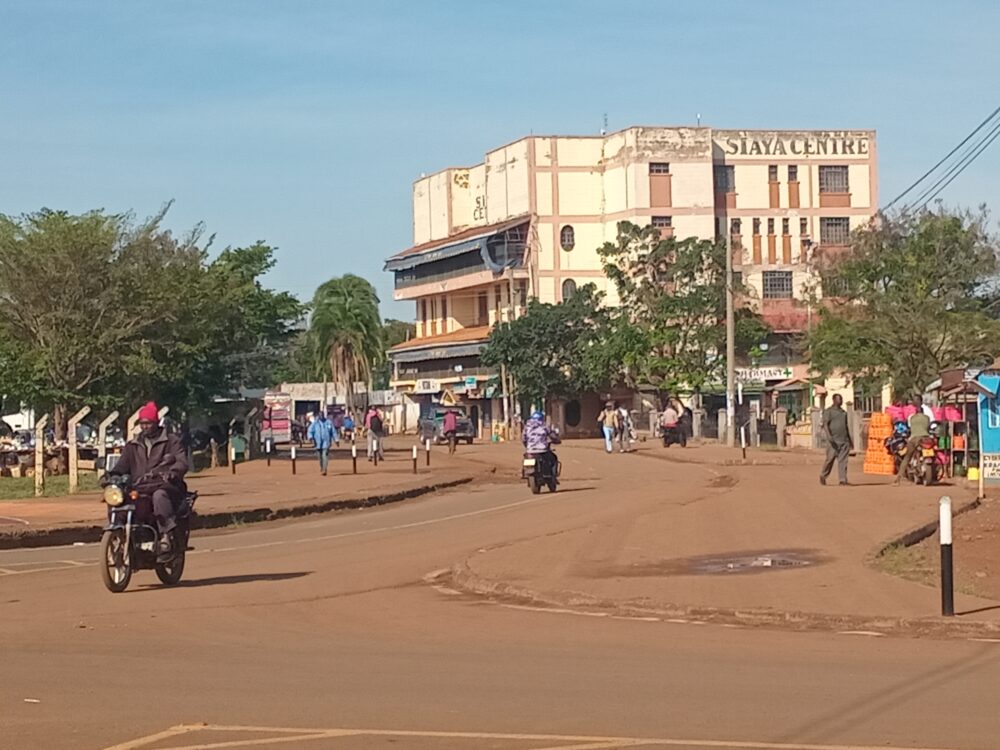
By Jack Ohito, DevReporter, Siaya County.

Key Highlights
- Siaya’s economy shows rapid macro growth
- However, average individual income remains low
- The concerns touch on issues at the heart of Sustainable Development Goal 8 and 9.
“ By 6 p.m., shops around Central Business District are already closing, says George Onyala, a resident of Siaya Township Location.
Siaya’s economy shows rapid macro growth, but average individual income remains low, at half the national average. The economy relies on low-value subsistence farming and fishing, trapping residents in highly competitive, low-margin retail trading. Due to a historic lack of manufacturing industries, capital frequently flows to nearby Kisumu.
According to national data from Stats Kenya, Siaya’s Gross County Product (GCP) per capita sits at roughly Ksh 151,968, which is about half of the national average. This translates directly to a lower average individual income, compared to industrialised or heavily urbanised counties.
Madam Persila Yvone, a businesswoman from Bondo Sub-County, says that she is concerned about the slow growth of Siaya Town compared to smaller towns such as Bondo and Ugunja.
“People of Siaya are not development conscious, look, in Bondo Sub County, we have all colleges and Hindus and investors are so many,” she says.
The concerns touch on issues at the heart of Sustainable Development Goal 8 and 9, which agitates for decent work and better infrastructure respectively.
The Kenya Vision 2030 development agenda also identifies infrastructure, economic growth and improved access to services as important drivers of national transformation.
Paul Ochieng a boda boda operator within Siaya town is optimistic that small-scale traders will benefit from improved connectivity.
“For traders, better roads are not simply about convenience. They can determine how quickly agricultural produce reaches markets, how much transport costs and whether customers and suppliers can move easily between towns,” says Paul.
Keeping Money Circulating Within Siaya
Samuel Otieno, a teacher who operates a private school in Siaya Town, says that the weak circulation of money within the local economy affects businesses and families.
His concerns point to another development challenge: how infrastructure can stimulate economic activity and improve household incomes.
“Expansion of infrastructure increases market based,” he explains.
Article 174 and 10 [of Kenya’s Constitution], recognises the objectives of devolution and establishes participation of the people, equity, inclusiveness and sustainable development among the national values and principles of governance respectively.
For Siaya residents, therefore, development is not merely about having the county headquarters located in the town. It is about seeing that status translated into opportunities, infrastructure, investment, jobs and better services.
Government Projects Raise Fresh Hopes
President William Ruto’s recent development tour of Siaya County has pledged to inject massive capital and infrastructure upgrades designed to unlock the local economy. By launching a multi-billion shilling package under the Bottom-Up Economic Transformation Agenda (BETA), the national government is directly targeting the structural bottlenecks that have historically kept household incomes low in Siaya.
“The government of Kenya has budgeted the historical 60 billion in Siaya County to improve roads, markets, housing and hospital ,” says President Ruto.
As new roads and public facilities take shape, residents will be watching to see whether the projects can help transform Siaya from an administrative centre into a more vibrant economy where businesses stay open longer, young people can find opportunities and development is felt in everyday life.



 Radio Baraza


