


By Dommie Yambo-Odotte and Edwin Wanjawa
As the world marks Men’s Mental Health Month this June, we are compelled to confront an uncomfortable reality: while men continue to occupy positions of visibility in politics, business, religion, and public life, many remain invisible in conversations about emotional wellbeing and mental health.
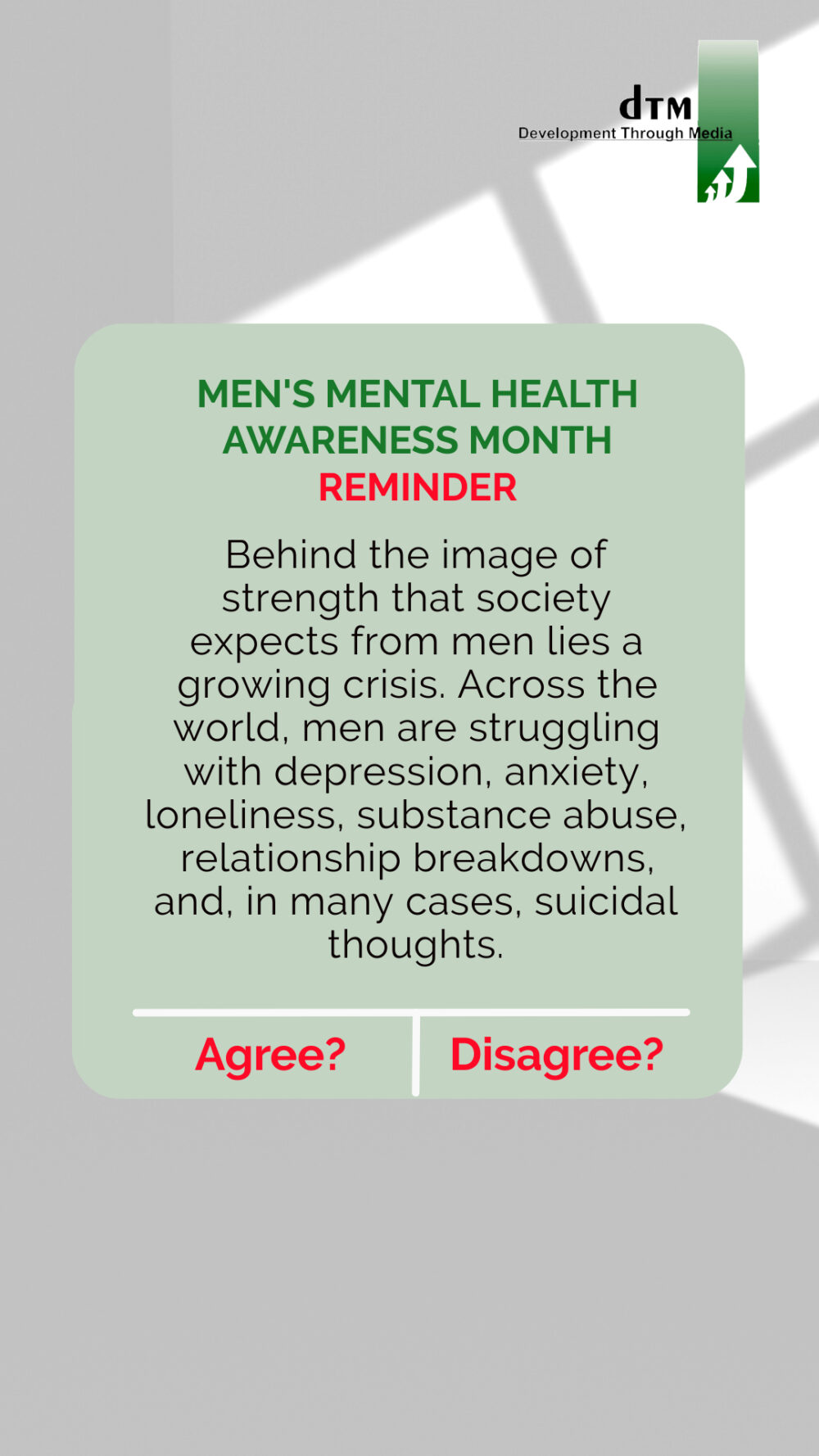
Behind the image of strength that society expects from men lies a growing crisis. Across the world, men are struggling with depression, anxiety, loneliness, substance abuse, relationship breakdowns, and, in many cases, suicidal thoughts. Yet these struggles often remain hidden behind silence, stigma, and societal expectations that equate masculinity with emotional invulnerability.
The paradox is striking. Men are expected to lead, provide, protect, and persevere. However, they are rarely given permission to express fear, uncertainty, grief, or emotional pain. From childhood, many boys are socialized into a culture that discourages vulnerability. Phrases such as “be a man,” “boys don’t cry,” and “man up” continue to shape attitudes towards emotional expression, often with devastating consequences.
The consequences are visible everywhere. Rising rates of alcohol and substance abuse among men, increasing family breakdowns, workplace stress, and growing social isolation are not merely social challenges; they are also mental health concerns. Unfortunately, public discourse often treats these issues separately, overlooking the intricate relationship between psychosocial wellbeing and broader socio-economic realities.
Mental health cannot be detached from the conditions under which men live. A father unable to provide for his family due to unemployment, a young graduate facing prolonged joblessness, a husband burdened by debt, or a retiree struggling with loss of identity is not simply facing an economic challenge. He is also navigating a psychological and emotional struggle. The anxiety, frustration, hopelessness, and diminished self-worth that emerge from these experiences have profound implications for mental wellbeing.
While men across the globe experience mental health challenges, the contexts differ significantly between the Global North and the Global South. In many developed countries, loneliness, social isolation, and weakening family structures have emerged as major drivers of poor mental health among men. In contrast, men in many African societies grapple with poverty, unemployment, political uncertainty, and limited access to mental health services. Yet despite these differences, the underlying human needs remain the same: dignity, belonging, purpose, connection, and hope.
In Kenya, conversations about mental health have gained momentum in recent years. However, much of the focus has understandably centred on youth, women, and vulnerable populations. While these groups deserve continued attention, there is a growing need to intentionally address the mental health needs of men and boys. Ignoring this issue comes at a cost not only to individual men but also to families, communities, and society as a whole.
A mentally healthy man contributes positively to his family, workplace, and community. Conversely, unresolved mental health challenges often manifest in harmful ways, including violence, substance dependence, disengagement from family responsibilities, and declining productivity. The wellbeing of men is therefore not a men’s issue alone; it is a societal issue.
This is where Civil Society Organizations (CSOs) have an indispensable role to play. Beyond service delivery and advocacy, civil society has the capacity to challenge harmful social norms, create safe spaces for dialogue, and promote community-based approaches to mental wellness. Organizations working in governance, development, education, health, and social justice must increasingly integrate mental health considerations into their programming.
At Development Through Media (DTM), we recognize that storytelling is a powerful tool for social transformation. Media platforms like ours have the ability to shape public attitudes, challenge stereotypes, and amplify voices that are often unheard. Through strategic communication, digital engagement, community dialogues, and media advocacy, DTM seeks to foster conversations that humanize men’s experiences and encourage help-seeking behaviours.
Overall, the media must move beyond sensational reporting of mental health crises and instead contribute to informed public discourse. Stories of resilience, recovery, responsible fatherhood, positive masculinity, and emotional wellbeing deserve greater prominence. Conversations about mental health must be normalised in the same way we discuss physical health.
Women also have a critical role in advancing men’s mental wellbeing. Mothers influence how boys learn to process emotions. Spouses and partners often serve as the first line of emotional support. Daughters, sisters, nieces, and female relatives frequently provide the social connections that protect men from isolation. However, supporting men’s mental health should not be interpreted as transferring responsibility to women. Rather, it calls for strengthening relationships that encourage empathy, communication, and mutual support.
Ultimately, the conversation on men’s mental health is not about creating competition between men and women or ranking suffering. It is about recognizing that different groups face distinct challenges that require thoughtful and context-specific responses. Healthy societies are built upon healthy relationships, healthy families, and healthy individuals—both men and women.
As Kenya continues to navigate rapid social, economic, and technological change, there is an urgent need to redefine what it means to be a man. True strength is not found in silence. It is found in the courage to seek help, the wisdom to express vulnerability, and the resilience to overcome adversity through connection and support.
This Men’s Mental Health Month, let us move beyond awareness campaigns and symbolic gestures. Let us create environments where men can speak openly without fear of judgment, access support without stigma, and pursue wellbeing without shame.
The future of our families, communities, and nation may depend on it.
About the Authors
Dommie Yambo Odotte, a media practitioner and Applied Psychologist, is the Executive Director/Producer at Development Through Media (DTM). Edwin Wanjawa, a Sociologist and Media Scholar, Teaches at Pwani University, and is Programme Associate (Monitoring, Learning & Evaluation) at DTM.
Development Through Media (DTM) is one of the first non-profit Media-Focused Civil Society Organisation (M-CSO) to register in Kenya in 1996, where it has operated since 1997. It works at an individual organisational level, and especially through partnerships with both media and non-media entities based in Kenya and across the world.
Contact: Info (at) dtmafrica.com



 Radio Baraza