


By Kipkorir Tarus, DevReporter, Trans Nzoia County

Key Highlights
- Many farmers in Kenya are unaware of the importance of soil testing and believe it to be too costly.
- Soil testing assesses nutrient levels, pH, crop suitability, and provides soil-specific fertilizer recommendations.
- The government, through Kenya Agricultural and Livestock Research Organisation (KALRO), is currently testing and analysing 77,000 soil samples across 45 counties.
- Results from these tests will contribute to the development of a digital soil map and a soil analysis database in Kenya.
Why are the majority of small-scale farmers in Kenya struggling to feed their households and the nation, despite government subsidies on farm inputs?
After speaking with several farmers, Radio Baraza found that many have not tested their soil.
Belief that Soil Testing is Prohibitively Expensive
A significant number of farmers hesitate to test their soils due to the belief that soil testing is prohibitively expensive.
One such farmer is Tom Nyagechanga, chairperson of the Kenya National Farmers Federation (KENAFF).
In an exclusive interview with Radio Baraza at his farm in Naisambu village, Kiminini Constituency, Nyagechanga recalled the challenges he faced when he attempted to test his soil at the Kenya Agricultural and Livestock Research Organisation (KALRO) laboratory in Trans Nzoia.
According to Nyagechanga, the challenges also included inadequate awareness creation on the importance of soil testing among farmers and poor access to testing laboratories.
“We need not only to have awareness about the importance of soil testing but also laboratories in every ward and ongoing training,” Nyagechanga emphasised.
John Komen, a farmer from Kapsitwet village in Kwanza Constituency, is one of the few who understand the condition of their soil. In 2018, the County Government of Trans Nzoia funded soil testing across all 25 wards.
“I learned that my soil is very acidic and received recommendations on the appropriate fertilizer to use,” Komen stated.
Similar to Nyagechanga and Komen, Rose Njenga, a young small-scale farmer in Saboti, has yet to test her soil because she cannot afford between KSh. 1,500 and 2,000 for sample collection and analysis.
Other farmers, like Lucky Labista, continue to rely on traditional methods for assessing soil quality, such as examining its colour and texture.
Digital Soil Map
To achieve food security in Kenya and fulfil the second Sustainable Development Goal (SDG) of ending hunger, the government is investing in soil health.
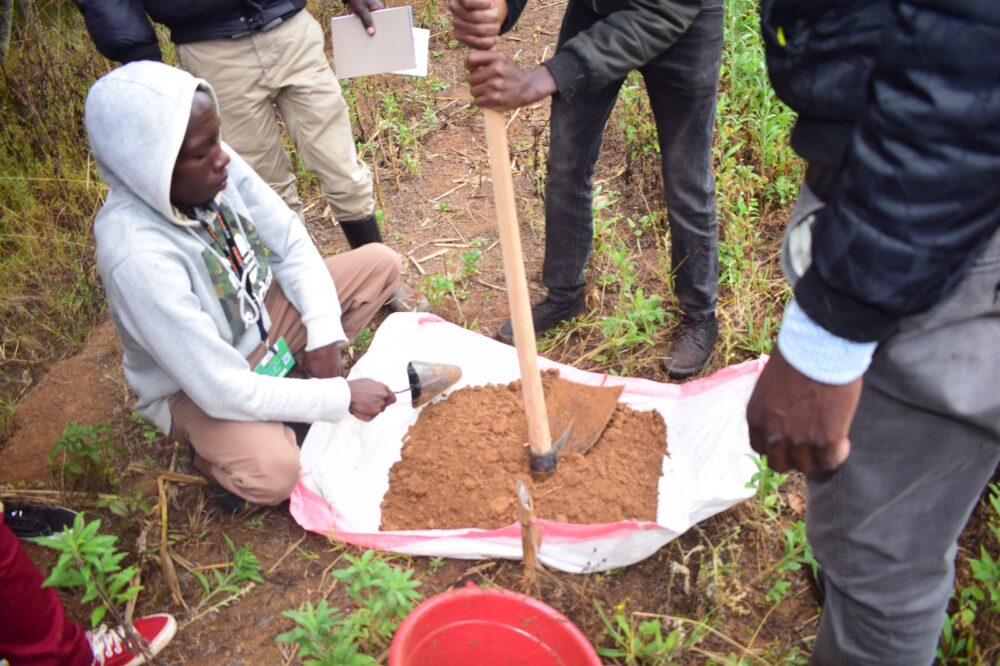
Currently, the Kenya Agricultural and Livestock Research Organisation (KALRO) is testing 77,000 soil samples as part of the National Agricultural Value Chain Project (NAVCPD).
This project is being implemented by agripreneurs and ward agricultural officers across 45 counties.
Upon completion of this nsationwide initiative, the government will create a digital soil map to guide farmers on the appropriate fertilizers to use. This effort aligns with Article 43(1)(c) of the Constitution of Kenya, which guarantees the right to food.
Paddy Likhayo, Managing Director of KALRO’s Food Crops Research Institute, emphasised that soil testing is crucial for assessing soil health.
“Healthy soil contains all the essential nutrients needed for high agricultural productivity. This is a critical component of our food and nutrition security agenda as a country,” Likhayo stated.
Elkana Nyambati, Assistant Director of Livestock at KALRO, noted that declining agricultural productivity in Kenya is partly due to the overuse of fertilizers without proper soil testing.
“We piloted this initiative in Kiambu and Kajiado, and we are now extending it to the other 45 counties in Kenya. Developing a digital soil map is our primary objective. This map will serve as a guide for both farmers and the government regarding fertilizer use,” Nyambati explained.
Mary Koech, a soil scientist at KALRO’s Food Crop Research Institute in Kitale, highlighted that the soil testing initiative aims to enhance agricultural productivity. She stated that this effort contributes to the economic growth and environmental sustainability goals outlined in Kenya Vision 2030.
“The purpose of this activity is to assess the current soil status and develop digital soil maps that will inform fertilizer use and policy recommendations,” she added.
The initiative will also create a soil analysis database, which will aid in formulating policy recommendations.
Simon Mwombe, Director of Agriculture in the Trans Nzoia County Government, encouraged farmers in all 25 wards to submit their soil samples for testing.
“Our farmers are hardworking, but we want them to take ownership of this process to achieve the best results and ensure the optimal use of fertilizers,” he urged.
Government facilities such as KALRO, the Ministry of Agriculture, and several private laboratories, including CropNuts, universities, and agricultural institutions, offer soil-testing services for a fee.
For the food and nutrition security agenda to become a reality, soil testing must be more accessible and affordable.
National and county governments should organise more field days and exhibitions to promote soil testing, while agricultural extension officers should actively educate farmers in rural areas about the benefits of soil testing.
Related stories
https://www.kenyanews.go.ke/kalro-develops-digital-soil-maps-to-boost-agricultural-productivity/