


By Edwin Wanjawa and Dommie Yambo-Odotte
On this fifth day of the 16 Days of Activism, 2025, Development Through Media (DTM) continues spotlighting one of the most urgent and fast-evolving arenas of Gender Based Violence: The Digital World.
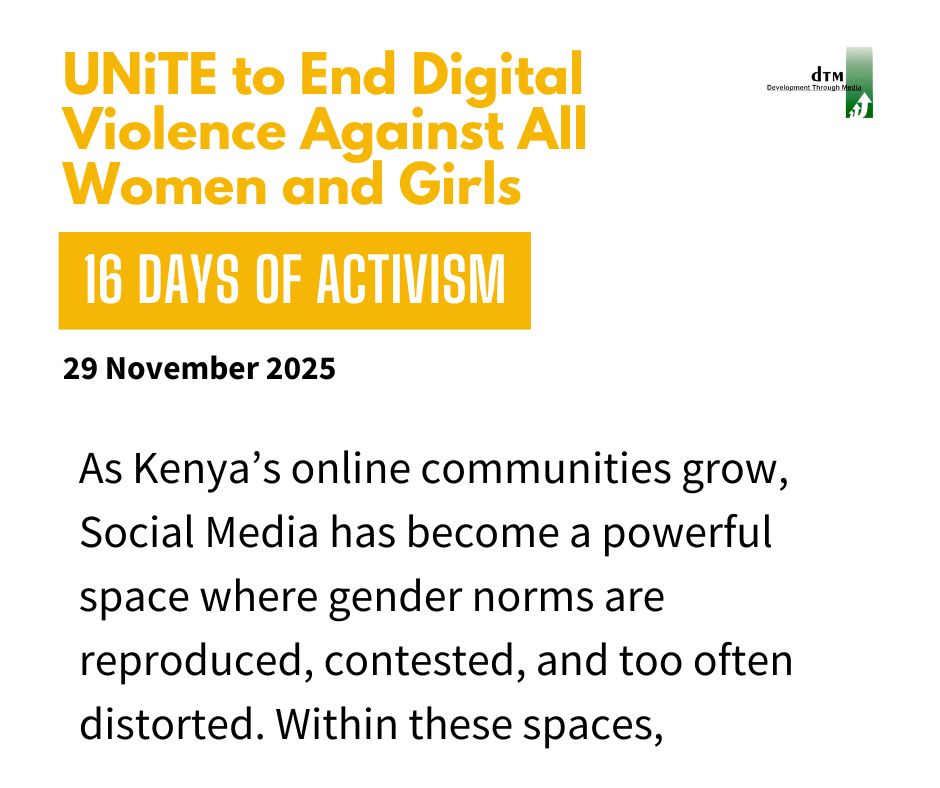
As Kenya’s online communities grow, Social Media has become a powerful space where gender norms are reproduced, contested, and too often distorted. Within these spaces, online misogyny is thriving—shaping attitudes, fuelling hostility, and normalising violence against women and girls.
Across platforms like TikTok, YouTube, and X, a new wave of influencers has built massive audiences by promoting anti-feminist, hyper-masculine, and exclusionary ideologies. Often wrapped in the language of “relationship advice” or “traditional values,” these narratives cast women as manipulative, morally suspect, or responsible for men’s struggles. While Kenya may not have a formal incel movement, similar patterns—entitlement, resentment, and deep suspicion of women’s autonomy—are increasingly visible in male-only online groups, anonymous forums, and comment sections that reward hostility and mock empathy.
One of the most insidious vehicles for these ideas is humour. Jokes about domestic violence, memes that portray women as commodities or burdens, and viral trends that glorify dominance circulate freely and rapidly. Because they are framed as entertainment, they mask the seriousness of the underlying messages, making violence seem trivial or deserved. This form of humour quietly reshapes social attitudes, especially among young men, reinforcing the broader culture that excuses femicide, intimate partner violence, toxic masculinity and daily microaggressions.
The consequences are not virtual abstractions. Women in public life—journalists, activists, academics, students, and professionals—face relentless harassment and intimidation online. Many are silenced, retraumatised, or driven offline altogether. What happens on the screen reflects, reproduces, and often worsens what women face offline. The digital arena has become both a mirror and a multiplier of GBV.
Amid this challenge, DTM has a critical role to play. Through ethical storytelling, fact-based narratives, and creative media production, DTM endeavours to challenge harmful online ideologies and disrupt the echo chambers that normalize misogyny. By promoting positive masculinity, amplifying women’s voices, debunking harmful stereotypes, and strengthening digital literacy, DTM’s efforts aim to reshape the culture of Kenya’s online spaces. This work is essential for building a digital environment grounded in respect, safety, and justice.
As we mark this Fifth Day of 16 Days of VAW 2025, we are reminded that the fight against GBV must extend into our digital lives. Online misogyny is not harmless—it is part of the ecosystem that makes violence thinkable, acceptable, and repeatable. Addressing it is not optional; it is central to creating a society where all women and girls can thrive.
Edwin Wanjawa is the Programmes Associate, DTM and Dommie Yambo-
Odotte is the Executive Director and Producer, DTM