


By Grace Wamaitha, DevReporter, Nakuru County

Highlights
- Nakuru farmers grow sunflower to cut oil imports bill.
- Kenya spends Sh160B annually on importation of edible oils.
- Sunflower is drought-tolerant.
- Sunflower Farming creates jobs and opportunities for youth and women.
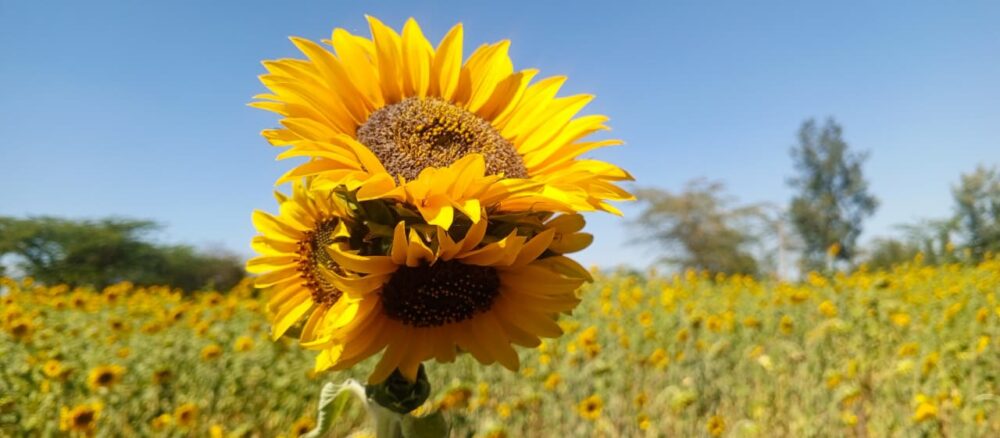
As edible oil prices hike and imports drain the country’s coffers, Nakuru farmers are planting a solution under the blazing sun. The golden oilseed, sunflower, is fast becoming a climate-resilient lifeline.
Kenya spends at least Sh160 billion annually, importing edible oils, mainly from East Africa countries like Uganda and Tanzania; and Southeast Asian countries, underscoring the country’s heavy dependence on external markets for basic food commodities.
In an effort to curb this dependency, Nakuru County, has rolled out a sunflower promotion project with the support of Agriculture and Food Authority (AFA) through its Nuts and Oil Crops Directorate.
The county aims to expand sunflower farming from 12,500 acres to over 30,000 acres across all eleven constituencies, in the next three years. The project will at the same time, offer farmers a crop that is relatively drought-tolerant and adaptable to changing weather patterns.
Why are farmers in Nakuru embracing the golden oilseed?
Over 12,000 farmers across Nakuru have benefited from 45 tons of sunflower seeds, signaling momentum in local production.
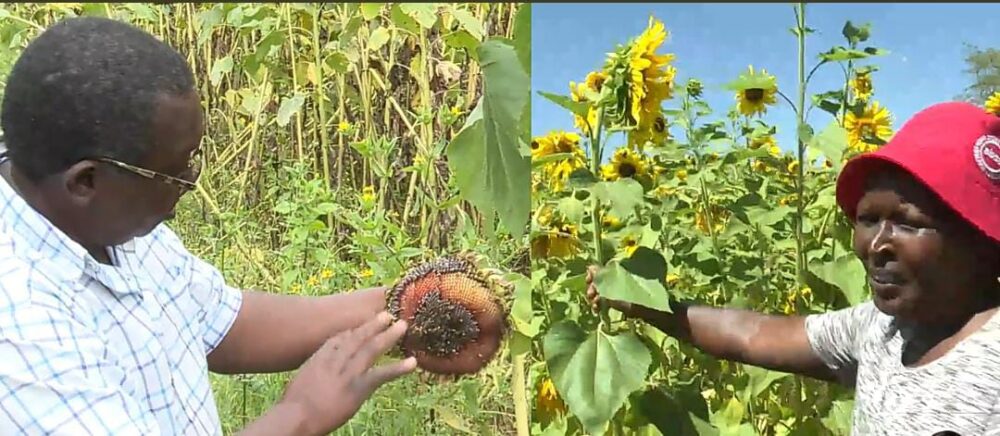
In Solai ward, Billy Bomet is ready to harvest his seven-acre sunflower farm.
“Sunflower has a ready market, and the returns are better compared to other crops,” he says. “It is reliable, even when the rains delay.”
On average, farmers harvest about 1,000 kilograms of sunflower seed per acre, earning between Sh60,000 and Sh70,000, depending on market prices. This is in contrast with maize, which is highly sensitive to rainfall variability.
Just a few kilometers away, in Visoi ward, Jane Korir is harvesting her one-acre sunflower plot.
“Sunflower is drought-resistant, and it grows well even when rains are unpredictable,” she says.
“We have also been trained in conservation agriculture, which helps maintain healthy soil and sustainable yields. Despite this place being semi-arid, the crop grows well,” she adds
Kenya’s reliance on imported edible oils: how heavy is it?
66 per cent of edible oils consumed locally is sourced from outside the country. Kenya produces only 34 per cent of its edible oil.
Kenya’s dependence on edible oil directly touches on its constitutional food rights as stated in Article 43(1)(c). County-led initiatives for growing sunflower are a step toward fulfilling these rights.
Billy believes that the crop has huge potential;
“Sunflower is not just good for my farm, it can also be grown on a larger scale so that Kenya and our counties can engage in sustainable oil production,” he says.
Nakuru County Executive Committee Member for agriculture, Leonard Bor, says that Nakuru County is promoting oil crop farming to reduce imports and bring down the prices of cooking oil;
“Right now, Kenya produces less than half of its edible oil needs,” he says.
AFA further indicates that the cost of importing edible oils in the country has been growing at an average of 15 percent.
Can sunflower withstand a changing climate?
As the country struggles with the challenges of rising food costs and climate change, counties are turning to climate-resilient oil crops as part of the solution. This move essentially aligns with sustainable development goal (SDG 13), and offering farmers a crop that is relatively drought-tolerant and adaptable to changing weather patterns.
Lilian Samoei, a Nakuru County agricultural officer, says sunflower seeds are open-pollinated, so farmers can save and re-use them every season.
“It grows fast, it does not need much input, and can handle unpredictable rain patterns, making it a perfect crop for small-scale farmers,” she explains.
Just like any other crop, sunflower has the potential to give farmers steady harvests and hence, reliable income, allowing them to buy food, pay school fees, and get through hard seasons without falling into poverty.
Is Nakuru building a local edible oil value chain?
Jane, a sunflower farmer, says;
“On an acre of land, you can harvest at least 1,000 kilograms of sunflower seeds. When you crush them, every 4 kilograms of seeds yields a litre of cooking oil. So, from 1,000 kilograms of seeds, you get about 250 litres of sunflower oil. I really regret not planting even three acres,” she continues.
Beyond cutting the import bill, the sunflower initiative is also positioning farmers to tap into local agro-processing and value addition, thus creating opportunities for jobs along the supply chain.
David Mwangi, an Extension Officer at the county, highlights ongoing plans to protect farmers from inflated market prices.
“We are setting up a system for sunflower farming that ensures farmers are supported and the crop remains attractive,” he says.
Lily Langat, the Deputy Director at the Nuts and Oil Crops Directorate, noted that de-husking is one of the value-addition components that presents opportunities for youth employment.
“Young people can fabricate simple machines, provide de-husking services, and earn income,” she notes.
Nakuru’s sunflower impact
Mr Leonard Bor further notes that Nakuru County is now a leading sunflower producer in the country, and is currently expecting to yield 3,000 metric tones.
This figure represents only a fraction of national demand. Each locally produced ton reduces pressure on the Sh160 billion import bill, while also strengthening rural livelihoods and supporting domestic food systems.
Every acre of sunflower harvested in Nakuru tells a story of hope and progress. A story of adaptation, resilience, and a gradual shift toward food self-reliance, in a country in dire need for sustainable solutions to rising food costs.