

By Emanuel Kipkorir Tarus, DevReporter, Trans Nzoia County

Key Highlights
- The Mugumo tree is regarded sacred
- Two Mugumo trees fell down in Trans Nzoia, Bungoma
- Elders unsettled by the incidents, plan rituals
- 49 bulls set to be slaughtered to cleanse the community
For the Sabaot community living in Trans Nzoia and Bungoma counties, the Mugumo (fig) tree is far more than a natural landmark.
It is sacred. A spiritual shrine where prayers, rituals and sacrifices, are offered to Asis, their traditional God.
However, that connection was shaken in late August 2025, when residents of Toroso village in Cheptais, Mt Elgon Constituency, woke up to shocking news.
A massive branch of an old Mugumo tree known by locals as mokoyweet and estimated to be over 300 years old, fell during the night.
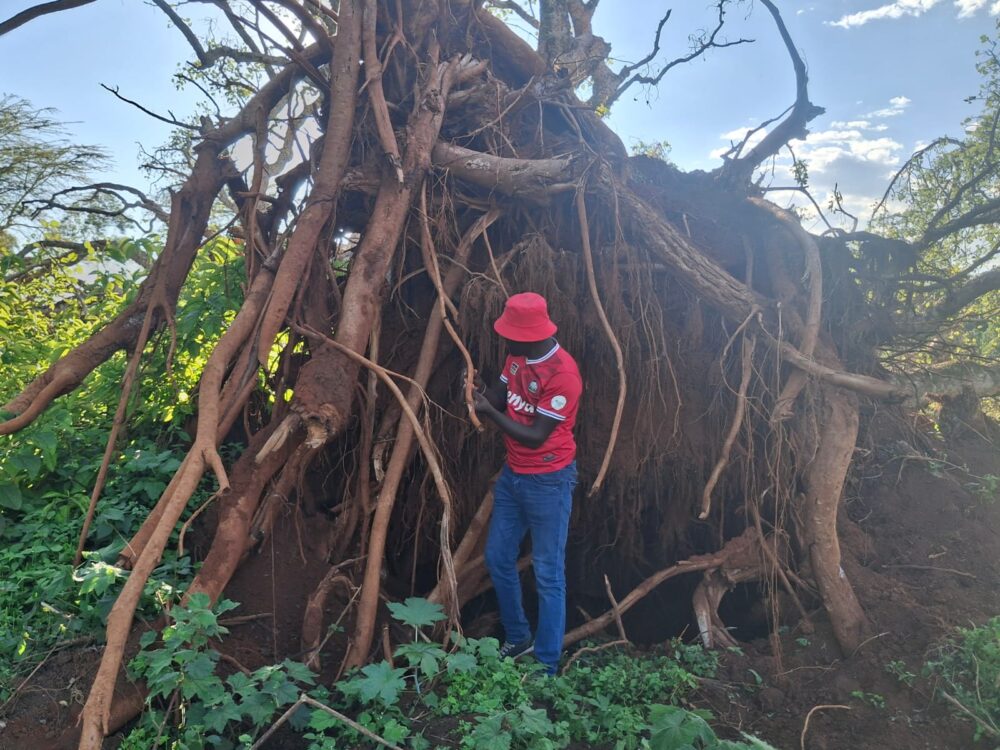
Two months later, on 30 October, 2025, another iconic Mugumo tree naturally fell in Endebess, Trans Nzoia County, during daytime.
While no injuries were reported, the falls ignited intense discussions among residents, elders, political leaders and environmentalists.
Sacred Symbols or Environmental Assets?
Indigenous trees such as the Mugumo, play a vital role in the ecosystem. They store carbon, absorb pollutants and contribute to climate change mitigation, aligning with Sustainable Development Goal 13 (Climate Action).
Before the trees fell, sharp differences had emerged between cultural elders and a section of political leaders. Cultural Elders argued that the sacred trees should be uprooted to mark the end of what they described as 100 years of curses, disunity and lack of peace.
On the other hand, political leaders including Mt Elgon Member of Parliament, Fred Chesebe Kapondi, opposed the move, warning that uprooting the trees could have negative social and political consequences.
“The Trees Spoke”
Anthropologist Peter Chemasuet dismisses claims that the Mugumo trees fell due to old age.
Speaking authoritatively, he noted that such trees are central not only to culture but also to Kenya Vision 2030’s environmental pillar.
According to Chemasuet, the falls carried symbolic meaning.
“Trees spoke without using human language. They were telling the opposers that their time had come. Why are you trying to stop us from being uprooted?” he said. “The Endebess tree fell during the day, while the Cheptais one broke at night — a form of communication to the community.”
Breaking Century-Old Curses
For elders like Manyoror Arap Mulwo, the fallen trees reinforce a long-held belief that the community must undergo a ritual cleansing.
Speaking exclusively to Radio Baraza, Manyoror said that uprooting the trees and removing items buried beneath them by ancestors during dispersal, would symbolise a new beginning.
“It will signify peace on the mountain, unity among our people and success in all we do,” he said.
Plans for the cleansing ceremony are already at an advanced stage. All 49 original Sabaot clans are expected to gather at the sites of the fallen trees, where 49 bulls, each with specific ear markings representing a clan, will be slaughtered.
Participants will identify themselves by clan names and totems, with rituals focusing on reconciliation, healing and shared meals.
Women and children will attend the ceremony but their role will be limited to feasting.
Political Resistance and Youth Voices
However, resistance remains strong. Local leaders led by MP Fred Kapondi argue that the ritual is cultic and should not be allowed.
Despite being less attached to traditional beliefs, some young Sabaots such as Patrick Ndiema say elders should be respected.
“We have no objection because they are the custodians of our culture,” said Patrick Ndiema, a youth from the area.
Environmental Concerns
Environmental experts caution against cultural actions that may harm nature. Andrew Monari, an environmentalist, attributes the tree falls to climate change, prolonged heavy rains and weakened root systems.
“Such trees cannot just be cut or uprooted,” Monari said. “Anyone intending to interfere with them must consult the County Environment and Climate Change Committee, working with NEMA.”
He urged communities to protect indigenous trees while seeking culturally sensitive and environmentally responsible solutions.
Call to Action
Will the elders succeed in their quest to cleanse the Sabaot community of what they believe, are century-old curses?
What happens if the ritual fails — or is stopped altogether?
Related Stories
- https://nation.africa/kenya/counties/bungoma/elders-to-cut-down-cursed-fig-trees-mt-elgon-5233358
- https://www.standardmedia.co.ke/western/article/2001534480/youths-disrupt-meeting-to-discuss-uprooting-of-100-year-fig-tree-in-mtelgon
- https://www.standardmedia.co.ke/rift-valley/article/2001535803/elders-to-hold-cleansing-ritual-after-the-fall-of-two-trees-in-mt-elgon-and-endebess
- https://youtu.be/lSNOjqmTg8Y?si=2vGZQErR_yhT0zrN
- https://youtu.be/-jN7qPyQwXk?si=jK_RDz8ygOskV5wS