

By Hendric Makokha, On Attachment at Development Through Media
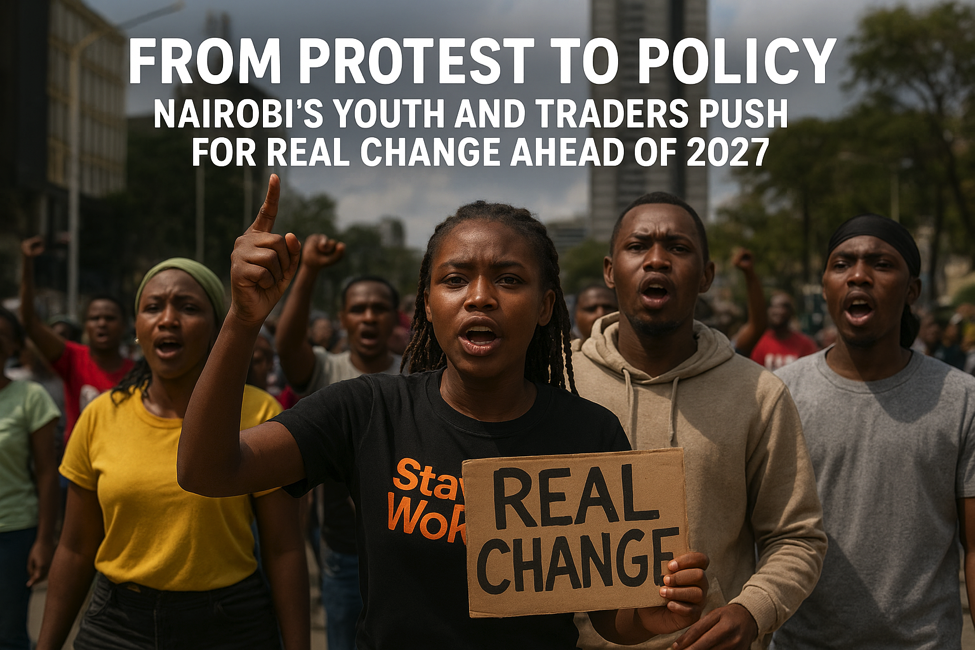
NAIROBI — As Nairobi’s campaign season warms up ahead of 2027, the city’s youth and small traders are sharpening their demands into concrete lists — and, into votes, when the time comes. After a year of recurrent protests and a painful June 2024 wave of unrest that left businesses looted and residents grieving, grassroots voices now say that they want more than slogans: they want measurable policy, protection of livelihoods, and meaningful inclusion in governance.
“We are tired of being used only during campaigns,” said Shon, a Gen-Z who has been active in the protests and digital accountability projects.
“We need seats at the table, budgets that work for us, and leaders who can explain how their promises will be delivered.” Okay Africa
For Nairobi’s traders, the immediate priority is security and recovery. Alice Kamau, who runs an electronics outlet in the CBD, described watching looters smash shop windows and walk away with laptops. “They came carrying sacks and packed the laptops into them. By the time the police arrived, it was too late,” she told reporters while surveying shattered glass and inventory loss. “We don’t oppose people demonstrating for their rights, but we want protection from criminals who take advantage of protests to destroy our livelihoods.” NTV Kenya
That sense of lost confidence is underscored by macro indicators. A private-sector survey in June showed activity contracting off the back of lower consumer spending and operational disruption tied to protests — a sign traders’ anxieties are not only anecdotal but economically consequential. “Weaker conditions were primarily driven by a solid contraction in business activity,” said the Stanbic Bank economist quoted in Reuters.
Some political actors are trying to translate those demands into policy. Businesswoman-turned-politician Agnes Kagure has framed her Nairobi bid around youth inclusion and local economic revival, promising innovation hubs, mentorship pathways and targeted job creation in Nairobi’s sub-counties. “In my incoming administration, the youth will not just be beneficiaries; they will be partners in transformation,” Kagure told supporters as she outlined plans to leverage the creative and tech economies. Tuko.co.ke – Kenya news.+1
On the national stage, new party platforms launched in mid-2025 also list youth employment and enterprise support as central pillars. The Democracy for the Citizens Party (DCP), unveiled by Rigathi Gachagua in May, includes manifesto items on promoting youth opportunities through investments in the digital economy, renewable energy and entrepreneurship — a policy emphasis aimed at formalising and expanding grassroots livelihoods. DCP Party Kenya+1.
But local activists and analysts say policy pledges must be paired with institutional reform to be credible. Civil-society groups and youth organisers call for transparent procurement, independent oversight on public funds, and county-level mechanisms that allow traders and youth to track budget implementation. “We cannot shout about bad governance without offering a systematic alternative,” one organiser reflected in mid-2025 commentary on the movement’s recent evolution. Okay Africa
Practically, Nairobi residents say they want a short list of deliverables: faster, lower-cost permits and market infrastructure for traders; municipal plans that reduce transport and logistics costs; vocational and digital-skills slots that link directly to employer demand; and transparent, localised oversight so budgets earmarked for market upgrades or youth programmes land where intended. Several county-level initiatives — including the Open Government Action Plan introduced in Nairobi for 2025–27 — provide a framework, but activists insist on stronger monitoring and community representation in implementation. Youth Agenda+1
The politics of delivery will be the test. Youth demographics give Nairobi a potential leverage point: organised registration drives and civic education campaigns aim to convert protest energy into turnout and sustained oversight. But analysts warn that unless economic pressure points — rising cost of living and fragile small businesses — are addressed, civic mobilisation may remain episodic rather than transformational. Reuters+1
For traders such as Steve Wafula, whose shoe-polishing stand sits near Moi Avenue, the calculus is immediate. “We need patrols, fast arrests when there is looting, and compensation mechanisms so that a single night of chaos does not close down a family business,” he said in June reporting on the CBD’s clean-up and recovery. NTV Kenya
As parties roll out promises, the demand from the streets is straightforward: convert rhetoric into budgets, implementable programmes and local accountability. If Nairobi’s youth and traders succeed in keeping pressure on after the next round of campaign rallies and hashtags, 2027 may produce not just new officeholders but new rules of engagement — where ordinary livelihoods and citizen oversight shape what policy actually looks like on the ground.