


By Edwin Wanjawa and Dommie Yambo-Odotte
On this ninth day of the 16 Days of Activism Against Gender-Based Violence, we turn to a quieter, more insidious form of abuse — one that plays out not in dark alleyways or behind closed doors, but in the bright glare of digital platforms. Cyberbullying and online harassment have become powerful tools in the war against women’s voices, especially those who dare step into leadership in politics, media, and academia.
In Kenya, as in much of the world, the digital public square is increasingly becoming a hostile environment for women who speak, lead, challenge, or demand accountability.
The attacks take many forms: misogynistic slurs, manipulated images circulated to evoke shame, coordinated smear campaigns meant to destroy reputations, threats of violence that often spill over into real life. For women in public life, the Internet is no longer just a place to connect with constituents or share research — it is a battlefield where gendered hate is weaponised with precision.
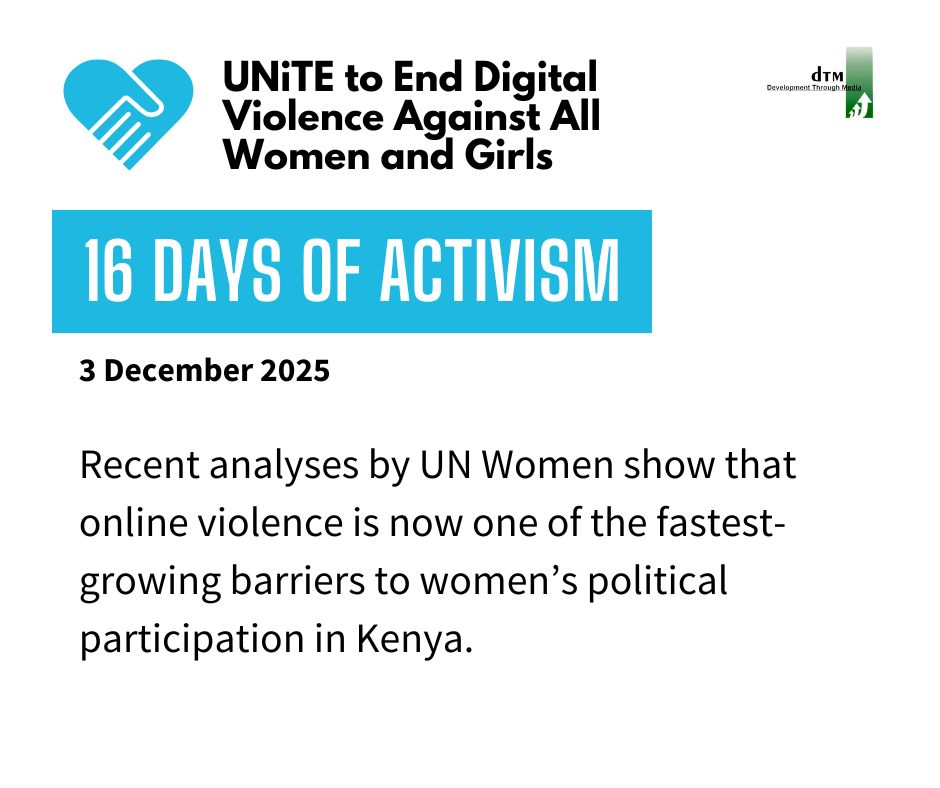
Recent analyses by UN Women show that online violence is now one of the fastest-growing barriers to women’s political participation in Kenya. Despite women being more than half of the population, they occupy less than a quarter of seats in Parliament. Digital harassment has become a major deterrent to seeking positions. Global studies mirror this picture: a UNESCO–ICFJ survey found that 73% of women journalists have experienced online abuse in the course of their work. Many received threats of death or sexual assault; some were later attacked offline. Online harassment, once dismissed as background noise, is now recognised as a serious occupational hazard.
What makes this violence uniquely damaging is the way it exploits patriarchal expectations. Attacks against women are rarely about policy positions or intellectual disagreements. Instead, they target femininity, sexuality, morality — domains where society still polices women harshly. A single rumour, a manipulated image, or a false story can spread with devastating speed, leaving women to manage not only the abuse but the reputational fallout, family questions, workplace stigma, and political consequences.
For women leaders, the impact is suffocating. Many retreat from social media, limiting what they post or withdrawing from political conversations altogether. Some abandon political ambitions. Others, especially young aspirants, simply choose not to enter the arena when they see what their peers endure. Online harassment thus becomes a subtle but powerful gatekeeping mechanism — a digital form of political violence that narrows the pipeline of women willing to lead.
In media spaces, women journalists navigate similar terrains. Those reporting on governance, corruption, gender-based violence or security face targeted harassment by networks seeking to intimidate them into silence. In academia, women scholars who research gender, governance, or human rights often find themselves subjected to coordinated attacks intended to discredit their work and discourage public engagement. It is not just individuals who suffer; the entire ecosystem of public knowledge and democratic debate is weakened when women’s voices are systematically pushed out.
For Kenya, this moment is critical. As the country moves closer to the 2027 general election, digital platforms will again become arenas for campaigning, persuasion, and contestation. Yet these same spaces remain largely unregulated, leaving women candidates exposed to relentless abuse. In our on-going research on the sociological and psychologial barriers facing women in competitive politics, women repeatedly speak of the fear of online harassment as a decisive factor shaping their political engagement. The anxiety of being ridiculed, sexualised, or falsely accused is powerful enough to keep brilliant, capable women, out of public life.
This should trouble all of us. A democracy where women cannot speak freely, where they cannot challenge power without being threatened or humiliated, is a democracy in decline. When women in media cannot report without abuse, the public loses truth-tellers. When women academics are bullied out of public debate, knowledge production suffers. And when women leaders retreat from digital spaces, political competition becomes less fair, less vibrant, and less representative.
Institutions like Development Through Media (DTM) have a crucial role to play in disrupting this digital violence. The media must turn its gaze toward the architecture of online abuse — who drives it, how it is coordinated, and what narratives it draws from. Newsrooms must learn to report on technology-facilitated violence with accuracy and sensitivity. Journalists and editors need tools to verify deepfakes and challenge smear campaigns before they spread. Civil Society and media organisations must establish rapid-response mechanisms offering legal support, psychosocial assistance, and digital security to women who are targeted. Most importantly, media and CSOs must help construct counter-narratives that affirm women’s leadership instead of reinforcing patriarchal stereotypes.
We must also advocate for stronger policy responses. Kenya needs laws explicitly addressing online violence against women in politics and public life. Digital platforms must be pushed to improve transparency around reporting, moderation, and takedown processes. And we must invest in digital literacy so that citizens recognise misogynistic disinformation for what it is: a tool to distort democracy.
Today’s digital violence is not only personal, it is also political. It is a deliberate strategy to exhaust women, to shame them into silence, to deny them access to public power. And yet women continue to speak, to lead, to run for office, to report the news, to teach, to research, to hold society accountable. Their resilience is a quiet defiance.
On this ninth day of the 16 Days of Activism, we honour that defiance — and recommit ourselves to building a digital environment where women can participate fully and freely. Cyberbullying and online harassment must be recognised not as collateral damage of the Internet age, but as a profound threat to gender equality, civic freedom, and democratic governance.
Protect women’s digital dignity is protecting democracy itself!
Edwin Wanjawa is the Programmes Associate, DTM and Dommie Yambo-
Odotte is the Executive Director and Producer, DTM

 Radio Baraza