


By Edwin Wanjawa and Dommie Yambo-Odotte
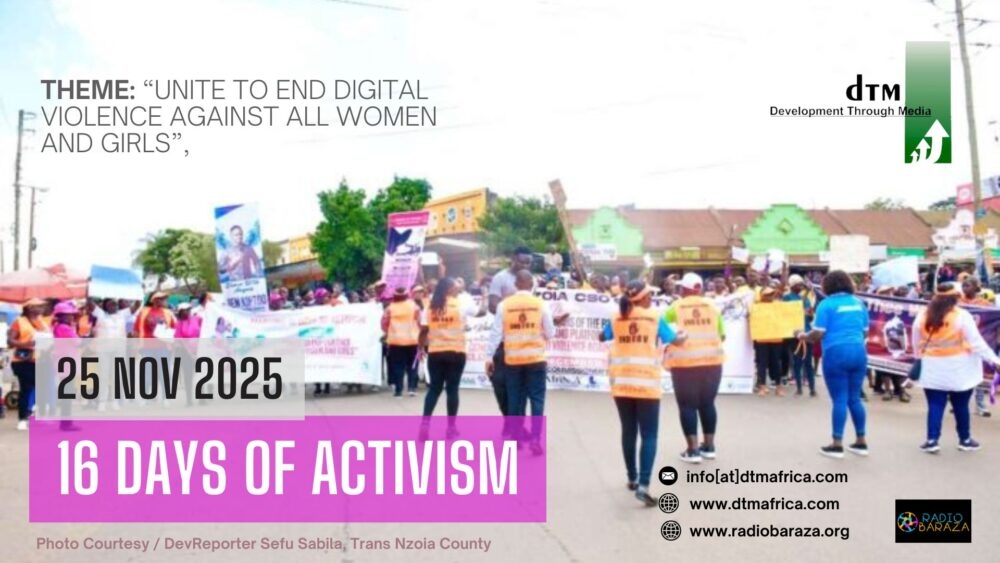
Every year on 25th November, the world marks the International Day to End Violence Against Women and Girls, launching the 16 Days of Activism Against Gender-Based Violence. In Kenya, this period comes against a backdrop of rising femicide, high levels of intimate partner violence, and an increasingly hostile environment—both online and offline—for women and girls. It is a moment for reflection, but more importantly, it is a moment for action.
Violence Against Women and Girls (VAWG) remains one of the most pervasive violations of Human Rights in the country. The Kenya Demographic and Health Survey (KDHS), confirms that one in every three Kenyan women experiences physical or sexual violence in her lifetime. This figure, grim as it is, barely captures the breadth of violence that shapes women’s daily realities: physical assault, economic deprivation, psychological abuse, coercive control, digital harassment, workplace exploitation, and harmful cultural practices that remain deeply entrenched.
Behind these statistics are stories—lived and often silenced. Over the past few years, Kenya has witnessed a disturbing rise in femicide, with young women being murdered by intimate partners or acquaintances. Some of these cases spark national outrage; most do not. The quick digital circulation of these tragedies creates a dangerous paradox: while social media amplifies awareness, it also risks normalising violence through sensationalism and desensitisation. A society that scrolls past brutality without indignation is one in decline.
For girls in informal settlements, violence is an everyday geography. Walking to school can be a dangerous journey. Unlit pathways, isolated routes, and predatory adults create unsafe environments that limit educational attainment and mobility. Meanwhile, in rural communities, harmful cultural practices—including FGM and child marriage—continue, sometimes driven underground, sustained by poverty and patriarchal Bargains.
In today’s world, violence is also digital. Women journalists, activists, content creators, politicians, and students are frequent targets of online misogyny, cyberbullying, revenge pornography, and coordinated harassment campaigns. These attacks are not merely “online drama”; they have real psychological, social, and economic consequences. For many, digital violence becomes a barrier to speaking, participating, or leading.
Survivors who seek help face a difficult path. Reports of insensitive police responses, files that go missing, delays in prosecution, witness intimidation, and community pressure to “settle the matter at home” paint a picture of a justice system struggling to protect those who need it most. Shelters remain too few, psychosocial support is limited, and stigma silences more cases than the law ever sees.
It is within this landscape that the 16 Days of Activism remain critical. The campaign is not symbolic—it is strategic. It forces national conversation, brings global attention, and compels institutions and individuals to examine their roles in perpetuating or ending violence.
But if Kenya is to truly shift the needle, media must be at the centre of the response. And this is where Development Through Media (DTM) plays a unique and indispensable role.
As a non-profit media Civil Society Organization (CSO), DTM operates at the intersection of communication, advocacy, and social transformation. For over two decades, DTM has championed the use of media to shape public discourse, amplify marginalised voices, and foster behaviour change. When it comes to VAWG, this positioning is not just relevant—it is essential.
The media shapes perception. It determines which stories matter. It influences how society understands violence, how survivors are portrayed, and how perpetrators are framed. Too often, Kenyan media—both mainstream and digital—has inadvertently perpetuated harmful stereotypes: by sensationalising violence, revealing survivor identities, romanticising harmful relationships, or using language that blames victims.
By integrating Applied Psychology and Sociology in its work, DTM aims to reverse this trend. Through capacity building for journalists, production of ethical content, community-based media programming, and advocacy for survivor-centred reporting standards, DTM pushes for a media landscape that is not only informative but transformative. This includes building the capacity of communicators on how to report GBV responsibly, how to identify harmful narratives, and how to centre survivor dignity and agency in storytelling.
DTM also works with communities—especially women, youth, and grassroots organisations—to ensure that the stories told about them reflect their lived realities. Media is most powerful when the people affected by violence are not just subjects but storytellers.
During the 16 Days, DTM amplifies voices of survivors, experts, social workers, women’s rights advocates, and community leaders. It creates platforms for conversations that cut across counties, generations, and social classes. It shines a light on systemic failures and champions accountability while offering practical pathways to prevention.
The role of a media CSO is not merely to report violence—it is to challenge the conditions that sustain it. It is to use storytelling as a tool of justice. It is to insist on dignity in representation. And it is to mobilise the public toward empathy, action, and long-term behavioural change.
As the campaign begins, we must confront an uncomfortable truth: progress has been made, but violence is evolving faster than our responses. Legislation exists, but enforcement lags. Awareness has grown, but behaviour change is slow. Online spaces have expanded, but digital safety has not kept pace.
Ending violence against women and girls will require collaborative efforts that bring together the state, civil society, religious institutions, traditional leaders, the private sector, and the media. And more importantly, it will require a collective decision to stop normalising harm.
The 16 Days matter because they remind us that violence is not inevitable. It is not cultural. It is not “a family matter.” It is a national issue. A democracy issue. A human dignity issue.
A Kenya free from violence against women and girls is within reach. But only if we choose it—and work for it. And in this work, media, led by organisations like DTM, must remain on the frontlines.
Edwin Wanjawa, Programmes Associate, DTM
Dommie Yambo-Odotte, Executive Director and Producer, DTM

 Radio Baraza