


By Hendric Makokha, On Attachment at Development Through Media
In the corridors of universities, community halls, and social media feeds across Kenya, there’s a growing murmur: young people want more than just protest. They want participation. As the 2027 general election draws closer, first-time voters—especially Gen Z—are poised to shift from passive observers to active change-makers. But significant challenges stand in their way.
Mobilization vs. Reality
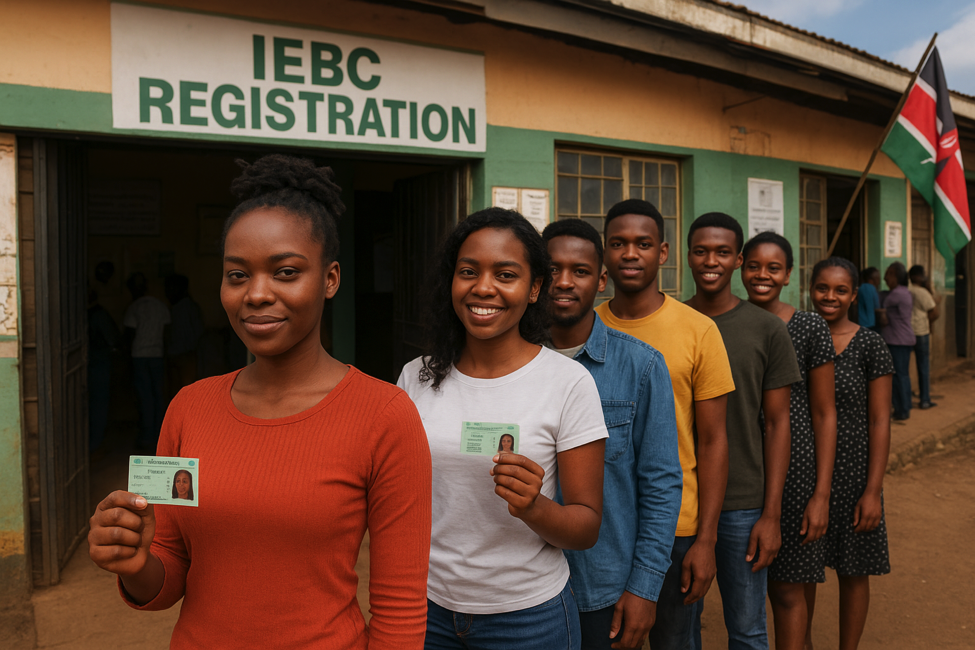
The Independent Electoral and Boundaries Commission (IEBC), has launched an ambitious drive: register 5.6 million new voters, largely drawn from youth who’ve just attained voting age.
A recent push includes a voter registration drive in institutions of higher learning, targeting over 2 million students (kenyanews.go.ke).
Yet in the first two weeks of the Continuous Voter Registration (CVR) exercise (as of October 8, 2025), only 20,754 new voters were added to the register, far below expectations (k24.digital).
Nairobi County recorded the highest number of register new voters, with 4,804 by the second week, followed by Mombasa and Kiambu (the-star.co.ke).
Barriers to Voting
Some of the bottlenecks are administrative: for many youth, obtaining a valid ID remains a hurdle. Until recently, first-time national ID applicants had to pay Sh300, while replacements cost Sh1,000. The fee for first-time applicants has since been scrapped, but delays in issuance still frustrate many (the-star.co.ke).
Awareness and access also remain key issues. The Elections Observation Group (ELOG) reported that in the first week of the registration drive, only 7,048 new voters registered—just 0.11% of the national target (the-star.co.ke). Some registration centres are far away, especially in rural or informal settlements, where young people often face travel costs and poor communication.
Voices from the Ground
“I came to register, but the nearest IEBC office is too far from my home. I hear about university drives, but what about areas like mine? If I’m struggling, many others will too.” Jane Mwangi, 19, first-time voter from Kiambu said.
Prof. XN Iraki, Lecturer, University of Nairobi adds, “The low voter turnout among young people is worrying but not surprising. Our research shows that structural barriers—such as difficulty obtaining valid identification, long distances to registration centres, and insufficient civic education—consistently reduce participation. For Gen Z, enthusiasm is high, but unless the systems are more accessible, much of that potential will remain unrealised.”
What Needs to Change
To ensure Gen Z and first-time voters have more than symbolic participation, Kenya must invest in:
- Accessible Registration and Identification Services
Many first-time voters still struggle to obtain national IDs or reach voter registration centres. IEBC should deploy mobile registration units in schools, markets, and remote areas — especially informal settlements in Nairobi, Kisumu, and Mombasa. Coordination with Huduma Centres and the National Registration Bureau can reduce waiting time for IDs. - Digital Civic Education
Traditional civic education campaigns rarely reach young audiences. Partnering with influencers, content creators, and youth-led NGOs on platforms like TikTok, Instagram, and X (Twitter) can make information about voting rights, registration, and electoral timelines more engaging and accessible. - Youth-Friendly Policy Engagement Spaces
Establish structured, youth-led policy dialogues at ward and county levels through the National Youth Council and county youth departments, among others. These forums should link young voters with local leaders and IEBC representatives for continuous engagement beyond elections. - Data Transparency and Accountability
IEBC should publish real-time registration data by age and county to foster transparency. Open data encourages accountability and motivates youth groups to track progress and push for reforms. - Inclusion in Political Parties
Political parties should comply with the two-thirds gender rule and introduce age quotas for youth representation. Mentorship programmes within parties would help young candidates gain campaign experience before 2027. - Civic Tech and Innovation
Support start-ups that build apps or SMS-based platforms to simplify voter registration tracking, polling station information, and results verification. Kenya’s strong ICT sector can make democracy more interactive and transparent.
Conclusion
The 2027 election is a defining moment for Kenya’s youth. Registration is just the first step. Transforming that into real political power requires persistence. Gen Z has already proven its ability to organize, protest, and demand better. Now, the challenge is to vote—and to hold leaders accountable long after the ballots are counted and results announced.



 Radio Baraza